How to Calculate Your GPA: A Simple Student Guide
If you have ever looked at your grades and thought, "how does this turn into one number?" you are asking the right question. GPA can feel weirdly stressful until you see the math once and realize it is just grade points, credit hours, and a weighted average.
GPA matters because schools and programs use it as a quick summary of your academic performance. Scholarships, academic honors, internships, transfer applications, graduate school, and even some first jobs may ask for it. That is why understanding how to calculate your GPA helps you plan instead of just react.
The good news is that the formula is not complicated. Once you know how grade points and credit hours work together, the whole system gets easier to follow. If you want the fast version, use our free GPA calculator while you read.
What is GPA and what does it actually measure?
GPA stands for Grade Point Average. It turns your letter grades into numbers and averages them in a way that gives more weight to classes with more credits. That last part matters because GPA is not just a simple average of A, B, and C grades.
This trips up a lot of students at first. If one class is worth 4 credits and another is worth 1 credit, they should not affect your GPA equally. Schools know that, which is why they weight the average by credits.
In practice, GPA measures academic performance over time. A semester GPA shows how you did in one term. A cumulative GPA combines everything you have taken so far. Both matter, but they answer slightly different questions.
What is the GPA formula?
The GPA formula is simple:
GPA = Total Grade Points / Total Credit Hours
Here is what that means. First, convert each grade into a grade-point value. Then multiply that value by the course credits. Add all of those grade points together. Finally, divide by the total number of credits attempted.
That is why GPA is a weighted average. A strong grade in a 4-credit course helps more than the same grade in a 1-credit seminar. A weak grade in a high-credit course also hurts more.
How do grade points work on a 4.0 scale?
Most schools in the U.S. use some version of the 4.0 scale. The exact plus/minus values can vary a little by school, but this is the common structure students see most often.
| Letter grade | Typical grade points | What it means |
|---|---|---|
| A | 4.0 | Excellent |
| A- | 3.7 | Very strong |
| B+ | 3.3 | Above average |
| B | 3.0 | Good |
| C | 2.0 | Average |
| D | 1.0 | Below standard |
| F | 0.0 | Failing |
Why do credit hours matter so much in GPA?
Because credit hours decide how much each class counts. This is the part students often miss the first time they try to do the math. GPA is not just averaging grade values. It is averaging them by credit weight.
Here is a quick example. An A in a 4-credit biology class produces more total grade points than an A in a 1-credit lab or seminar. The same is true in reverse for low grades. A C in a high-credit class drags the average down more than a C in a tiny elective.
This is why course strategy matters. If you are trying to protect or improve your GPA, focus attention on the classes carrying the most credits. That usually gives you the biggest academic payoff for your effort.
How to calculate your GPA step by step
If you want to do it by hand, use this process. Once you do it once, the formula becomes much easier to trust.
- List each course and the number of credit hours.
- Convert each letter grade to grade points.
- Multiply the grade points by the course credits.
- Add all grade points together.
- Add all credit hours together.
- Divide total grade points by total credit hours.
Example: how to calculate semester GPA
Let's use a realistic semester schedule. Imagine you took four classes and earned the following grades.
| Course | Grade | Credits | Grade points |
|---|---|---|---|
| Biology | A | 4 | 16.0 |
| English | B+ | 3 | 9.9 |
| History | B | 3 | 9.0 |
| Math | A- | 3 | 11.1 |
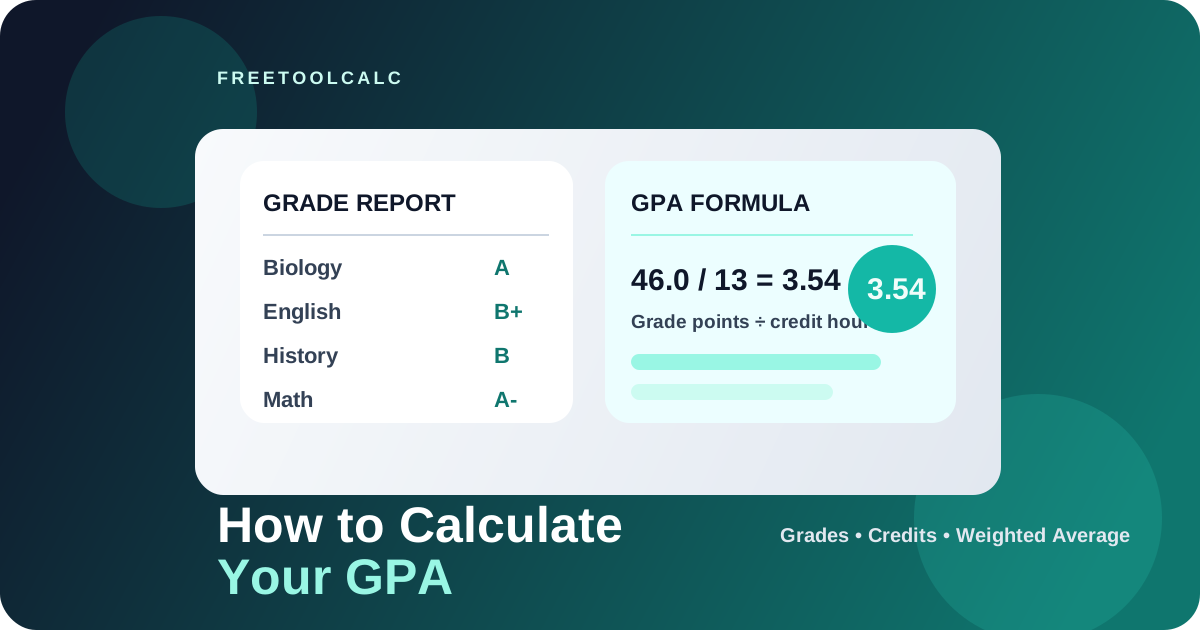
Now add everything up. Total grade points = 16.0 + 9.9 + 9.0 + 11.1 = 46.0. Total credit hours = 4 + 3 + 3 + 3 = 13. GPA = 46.0 ÷ 13 = 3.54.
So the semester GPA in this example is 3.54. This is exactly why the calculator is handy. The math is simple, but manual mistakes are easy when you are tired, stressed, or checking several scenarios at once.
How do you calculate cumulative GPA?
Cumulative GPA includes every semester, not just the current one. To calculate it, combine the total grade points from all past terms and divide by the total attempted credits across all those terms.
Here is a simple two-semester example. Say your first semester produced 43 grade points over 13 credits, and your second semester produced 46 grade points over 13 credits. Your cumulative GPA would be (43 + 46) ÷ (13 + 13) = 89 ÷ 26 = 3.42.
This is why one good semester can help, but not instantly fix everything. The more total credits you have completed, the harder it is for one semester to dramatically move your average. That can feel frustrating, but it also means one rough term usually does not define you forever.
| Semester | Grade points | Credits | Semester GPA |
|---|---|---|---|
| Semester 1 | 43.0 | 13 | 3.31 |
| Semester 2 | 46.0 | 13 | 3.54 |
| Cumulative | 89.0 | 26 | 3.42 |
Weighted vs. unweighted GPA: what is the difference?
An unweighted GPA uses the same scale for every class. On a standard 4.0 scale, an A is worth 4.0 whether it came from a regular class or an advanced one.
A weighted GPA gives extra value to harder courses. Many high schools add extra points for Honors, AP, or IB classes. That means an A might count as 4.5 or 5.0 depending on the system.
Neither system is automatically better. They simply answer different questions. Unweighted GPA shows raw grade performance. Weighted GPA rewards academic rigor. If you are comparing schools, scholarship rules, or admissions standards, always check which system they use before you panic about the number.
What people get wrong when calculating GPA
The biggest mistake is forgetting to multiply by credits. Students sometimes average the grade values directly, which gives the wrong answer if classes have different credit weights.
The second mistake is mixing weighted and unweighted scales. If your school uses a weighted GPA system, do not plug weighted grades into an unweighted formula or the reverse. That gives a result that looks precise but is not actually useful.
The third mistake is leaving out old semesters when calculating cumulative GPA. A cumulative GPA includes everything that counts toward the official average, not just the most recent term.
Can one bad grade ruin your GPA?
Usually not by itself. One low grade can hurt, but the actual damage depends on how many credits that class carries and how many total credits you have already completed.
A bad grade in a 1-credit class is not the same as a bad grade in a 4-credit core class. And if you already have a large number of completed credits, one course has less power to swing your cumulative average.
This is where perspective matters. GPA is important, but students sometimes assume one mistake destroys everything. In most cases, it does not. It just means your next few classes matter more.
How can you raise your GPA faster?
Focus on high-credit classes first. Improving a class worth 4 credits usually changes your GPA more than improving a class worth 1 credit. That does not mean low-credit classes do not matter, but if you are trying to make the biggest impact, that is where you usually start.
Look for preventable losses. Missing assignments, quiz zeros, avoidable late work, and skipped attendance points can drag down grades more than students realize. Fixing those small habits often improves GPA faster than searching for a perfect study trick.
And talk to instructors early. This part feels awkward, but it works. If you are struggling, the earlier you ask for help, the more options usually exist.
FAQ: real GPA questions students ask
How do you calculate your GPA by hand?
Multiply each grade value by the class credits, add those grade points together, and divide by total credits. That is the entire formula.
How do you calculate semester GPA?
Use only the classes from your current term. Add the grade points from those classes and divide by that semester's total credit hours.
How do you calculate cumulative GPA?
Combine all semesters that count toward your record. Add every grade point earned so far and divide by total attempted credits across all terms.
What is the difference between weighted and unweighted GPA?
Unweighted GPA treats every class the same. Weighted GPA gives extra value to advanced courses. Always check which one your school, scholarship, or application asks for.
Do credit hours matter?
Yes, a lot. GPA is a weighted average, so more-credit classes have a larger impact on the final number.
Can one bad grade ruin your GPA?
Usually not. It can hurt, but the effect depends on class credits and your total completed coursework. One bad grade is rarely the end of the story.
Here's the bottom line
Your GPA is just grade points divided by credit hours, but the weighting is what makes it matter. Once you understand that, semester GPA, cumulative GPA, and weighted versus unweighted grading all become much easier to follow.
If you want the fast version, calculate it directly. Use our free GPA calculator to test classes, credits, and grade scenarios in seconds. You can also pair it with our college savings calculator and student loan calculator if you are planning the bigger picture of school costs too.
Academic note
GPA systems vary by school, especially for plus/minus grading, repeated courses, pass/fail classes, and weighted high school transcripts. Always compare your hand calculation with your school's official policy if the number is being used for scholarships, transcripts, or admissions.
Try the GPA Calculator
Enter your classes, grades, and credits to calculate your GPA instantly.
Go to GPA Calculator ->