How to Calculate Break-Even Point for a Small Business (With Real Examples)
Before you can make a profit, you have to stop losing money. Break-even analysis tells you exactly how many sales — or how much revenue — you need to cover all your costs. It's one of the most valuable calculations any business owner can learn, and it takes about 10 minutes.
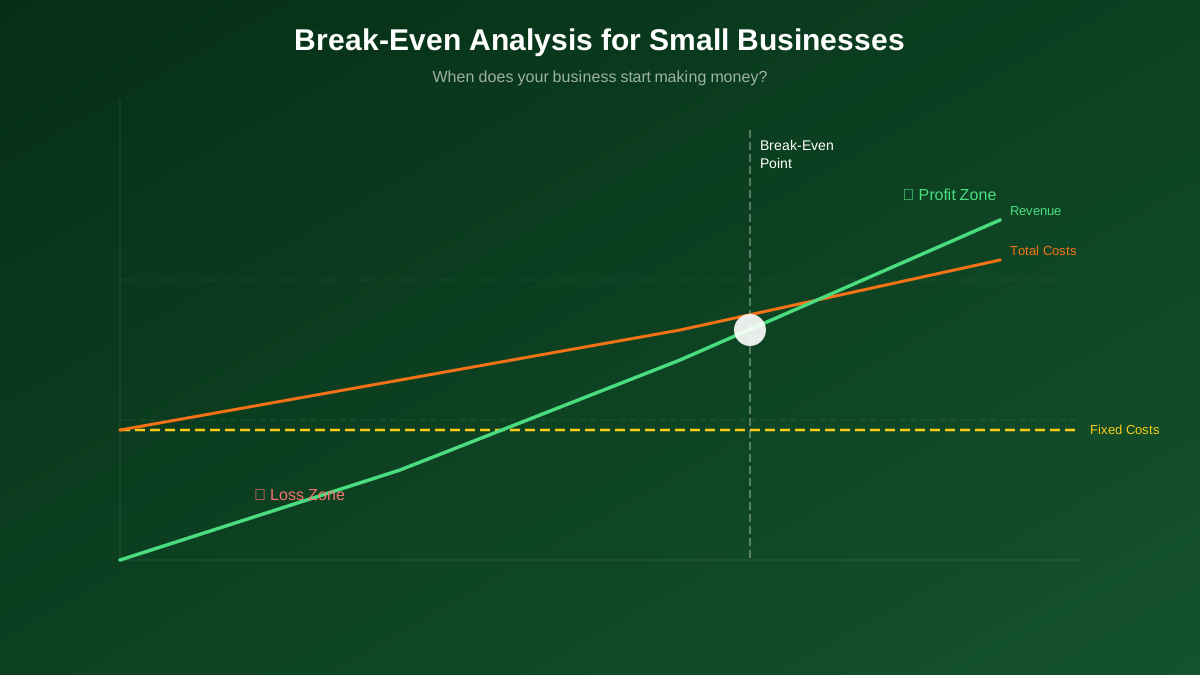
The Core Concepts: Fixed vs Variable Costs
Before running the numbers, you need to understand two types of costs that behave completely differently:
Fixed Costs
Expenses you pay regardless of how much you sell. They don't change whether you sell 10 units or 10,000 units this month.
- Rent / lease payments
- Salaried employee wages
- Insurance premiums
- Loan repayments
- Software subscriptions
- Your own owner's draw (if you count it)
Variable Costs
Costs that increase or decrease proportionally with your sales volume. Every additional unit sold adds more of these costs.
- Cost of goods sold (raw materials, manufacturing)
- Packaging and shipping
- Sales commissions
- Payment processing fees
- Hourly labor tied directly to production
The Break-Even Formulas
Break-Even in Units
Break-Even Units = Fixed Costs ÷ (Price per Unit − Variable Cost per Unit)
The denominator is called your Contribution Margin per Unit
Break-Even in Revenue (Sales Dollars)
Break-Even Revenue = Fixed Costs ÷ Contribution Margin Ratio
Where: CM Ratio = (Price − Variable Cost) ÷ Price
Example 1: Product-Based Business (Candle Shop)
You make and sell handmade candles. Let's calculate your break-even:
| Business Data | Amount |
|---|---|
| Selling price per candle | $28.00 |
| Variable cost per candle (wax, wick, jar, label) | $9.50 |
| Monthly fixed costs (rent, insurance, website) | $1,800 |
Contribution Margin per candle: $28.00 − $9.50 = $18.50
Break-Even Units: $1,800 ÷ $18.50 = 97.3 candles ≈ 98 candles/month
Contribution Margin Ratio: $18.50 ÷ $28.00 = 0.661 (66.1%)
Break-Even Revenue: $1,800 ÷ 0.661 = $2,723 in monthly sales
So you need to sell 98 candles per month (about 3.3 per day) just to cover your costs. Every candle sold after that puts $18.50 of profit in your pocket.
Example 2: Service Business (Freelance Designer)
Service businesses often have near-zero variable costs per sale, making the calculation simpler:
Monthly fixed costs: $2,400 (software, desk, insurance, phone)
Average project price: $800
Variable cost per project: $0 (you do the work yourself)
Break-Even Projects: $2,400 ÷ $800 = 3 projects per month
Hourly equivalent (assuming 10hrs per project): $800 ÷ 10 = $80/hr
Client number 4 this month is pure profit. This is why service businesses can be highly profitable once established — low variable costs mean the contribution margin ratio approaches 100%.
Using Break-Even Analysis for Pricing Decisions
Break-even is incredibly useful for testing pricing scenarios. Let's say you're considering dropping your candle price to $22 for a promotion:
New CM per unit: $22 − $9.50 = $12.50
New Break-Even: $1,800 ÷ $12.50 = 144 candles/month
(vs. 98 candles at regular pricing)
That price cut requires you to sell 47% more candles just to break even — before you see a single dollar of profit. A small discount has a massive impact on your break-even point.
Beyond Break-Even: Target Profit Calculation
You can extend this formula to calculate how much you need to sell to hit a specific profit target:
Units to Hit Target = (Fixed Costs + Target Profit) ÷ Contribution Margin per Unit
For our candle business targeting $3,000/month profit:
Units needed = ($1,800 + $3,000) ÷ $18.50
= 259 candles/month
= about 8.6 candles per day
💡 Common Break-Even Mistake: Forgetting Your Own Pay
Many solo business owners calculate break-even without including any payment to themselves. If you're not paying yourself a salary in your fixed costs, you're not actually breaking even — you're subsidizing the business with free labor. Include a minimum viable salary in your fixed costs from the start.
Run Your Break-Even Scenarios
Use our break-even calculator to run your own numbers instantly — test different price points, cost structures, and profit targets without doing the math by hand. For comprehensive startup planning, pair it with our ROI calculator to evaluate whether a new product line or business idea is worth pursuing.
Calculate Your Break-Even Point
Enter your costs and pricing to instantly find out how many sales you need to be profitable.
Go to ROI Calculator →