How to Calculate Your BMI: What It Means for Your Health
Body Mass Index is one of the most commonly used tools for assessing whether your weight is in a healthy range. Here's how to calculate it and what the results mean.
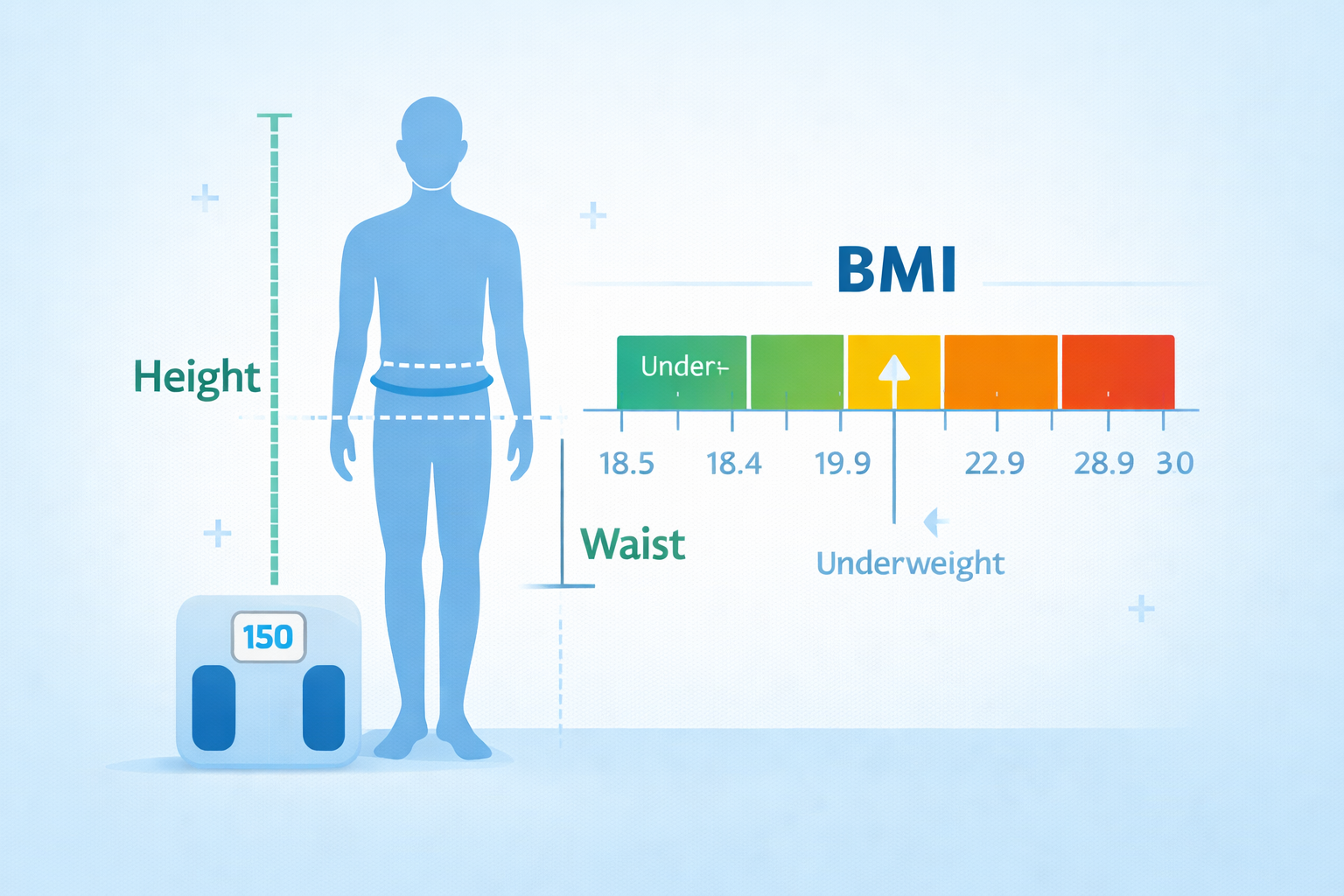
What is BMI?
Body Mass Index (BMI) is a calculation that uses your height and weight to estimate how much body fat you have. It's a simple screening tool that helps categorize people into weight groups that may lead to health problems.
While BMI doesn't directly measure body fat, it's strongly correlated with more direct measures and is used by healthcare providers as a quick way to assess weight-related health risks.
The BMI Formula
Calculating BMI is straightforward. You can do it yourself or use our free BMI calculator for instant results.
BMI = weight (kg) / [height (m)]²
For pounds and inches:
BMI = [weight (lbs) / height (in)²] × 703
Example: Calculating BMI
Let's say you're a 35-year-old woman who weighs 150 pounds and is 5'6" tall (66 inches):
- First, convert height to inches: 5'6" = 66 inches
- Square the height: 66 × 66 = 4,356
- Divide weight by height squared: 150 ÷ 4,356 = 0.0344
- Multiply by 703: 0.0344 × 703 = 24.2
A BMI of 24.2 falls in the "normal weight" category. Not bad! Use our BMI calculator to get your number instantly.
Understanding Your BMI Results
The Centers for Disease Control and Prevention (CDC) uses the following categories for adults:
| BMI Range | Category | Health Risk |
|---|---|---|
| Below 18.5 | Underweight | Higher risk of nutritional deficiencies |
| 18.5 - 24.9 | Normal Weight | Lowest health risk |
| 25 - 29.9 | Overweight | Increased risk of certain conditions |
| 30 or higher | Obese | Higher risk of health problems |
Limitations of BMI
While BMI is useful as a screening tool, it doesn't tell the whole story. Here's why:
- Muscle mass: Athletes with high muscle mass may have a high BMI but low body fat
- Age: Older adults may have a "normal" BMI but decreased muscle mass
- Ethnicity: Different populations have different health risks at various BMI levels
- Distribution: BMI doesn't measure where fat is stored - belly fat is more risky than hip fat
What to Do With Your BMI
If your BMI falls outside the "normal" range, don't panic. BMI is just one piece of the health puzzle. Here's what to consider:
For Underweight (BMI under 18.5)
- Focus on nutrient-dense foods
- Add healthy calories with nuts, avocados, and whole grains
- Consider working with a dietitian
- Check for underlying health conditions
For Overweight or Obese (BMI 25+)
- Don't focus just on the number - focus on health habits
- Move more: aim for 150 minutes of exercise weekly
- Focus on whole foods over processed ones
- Talk to your doctor about a realistic goal
- Use our calorie calculator to understand your energy needs
💡 Pro Tip
Instead of just focusing on BMI, track your waist circumference. Men with a waist over 40 inches and women over 35 inches have higher health risks, regardless of BMI.
BMI for Children and Teens
BMI calculation is different for those under 20. Instead of fixed categories, percentiles are used based on age and gender. Our BMI calculator automatically adjusts for age when needed.
Beyond BMI: Other Health Metrics
For a complete picture of your health, consider these additional measurements:
- Waist circumference: Measures belly fat
- Blood pressure: Indicates heart health
- Cholesterol levels: Shows heart disease risk
- Blood sugar: Indicates diabetes risk
Calculate Your BMI Today
Ready to find out where you stand? Use our simple free BMI calculator to get your number instantly. Remember, BMI is a screening tool, not a diagnosis. Always talk to your healthcare provider about what your results mean for you personally.
For a more complete picture of your health, try combining your BMI check with our BMR calculator to understand your metabolic rate and body fat calculator to estimate your actual body composition.
Calculate Your BMI Now
Use our free calculator to find out if your weight is in a healthy range.
Go to BMI Calculator →