How Much House Can I Afford? A Real Budget Guide
If you are asking how much house can I afford, you probably do not want a vague range. You want a number you can trust, a payment you can live with, and a clear next step before you talk to a lender.
Buying a home feels exciting right up until the math starts. This part trips up a lot of people, especially first-time buyers who are trying to balance rent, savings, debt, and today's mortgage rates all at once. The good news is that home affordability is not a mystery once you break it into a few pieces.
Your house budget starts with your monthly payment, not the listing price. A lender may tell you the maximum you can borrow, but that is not the same thing as what will feel comfortable in your real life. Use our free home affordability calculator to test your numbers while you read.
How much house can I afford using the 28/36 rule?
The simplest starting point is the 28/36 rule. It says you should aim to spend no more than 28% of your gross monthly income on housing and no more than 36% on total monthly debt. Housing means principal, interest, property taxes, homeowners insurance, and HOA dues if you have them.
Here is why people like this rule: it gives you a fast way to estimate your ceiling before you get lost in rate quotes and listing sites. Fannie Mae notes that debt-to-income ratio is a major part of mortgage underwriting, and the CFPB reminds buyers to plan for taxes, insurance, repairs, and other ownership costs, not just the loan payment. That is where many budgets go sideways.
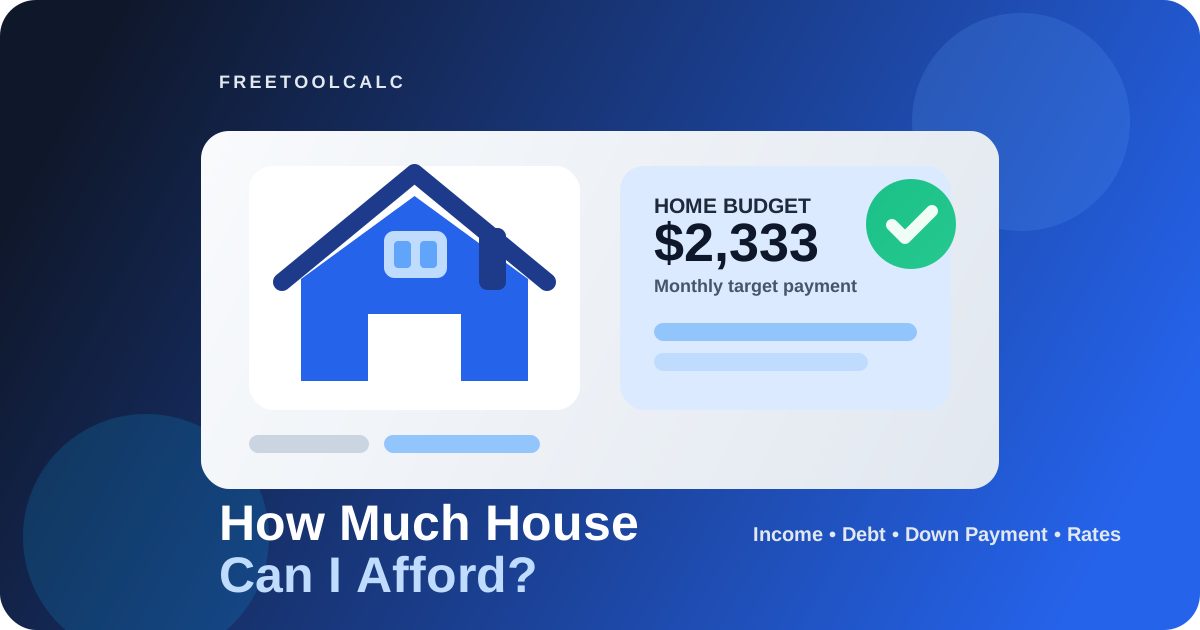
Start with your gross monthly income. If you earn $100,000 a year, your gross monthly income is $8,333. Using the 28% rule, your target housing budget is about $2,333 per month. Then you compare that against the 36% rule after adding your car payment, student loans, credit cards, and any other recurring debt.
| Annual income | Gross monthly income | 28% housing target | 36% total debt cap |
|---|---|---|---|
| $60,000 | $5,000 | $1,400 | $1,800 |
| $80,000 | $6,667 | $1,867 | $2,400 |
| $100,000 | $8,333 | $2,333 | $3,000 |
| $120,000 | $10,000 | $2,800 | $3,600 |
What costs count when you ask how much house can I afford?
This is the part buyers underestimate most often. The home price is only one piece of the monthly cost. Your real housing payment usually includes principal, interest, property taxes, homeowners insurance, mortgage insurance if your down payment is below 20%, and sometimes HOA dues.
Repairs matter too, even though lenders do not always count them. The CFPB tells buyers to set aside money for maintenance, repairs, moving costs, and improvements. That advice is more valuable than it sounds. A house can fit your mortgage approval and still wreck your cash flow if you have no room for the furnace, water heater, roof leak, or appliance replacement that eventually shows up.
Think in monthly buckets. If your target payment is $2,300, do not spend the full $2,300 on principal and interest alone. Leave room for the rest of the bill. That gives you a safer number and a less stressful life after closing.
| Cost category | What it covers | Typical monthly effect |
|---|---|---|
| Principal + interest | Loan repayment | Usually the largest piece |
| Property taxes | Local tax bill | $200 to $800+ depending on area |
| Homeowners insurance | Coverage for the home | $75 to $250+ depending on risk |
| Mortgage insurance | Extra cost for lower down payments | $100 to $300+ for many buyers |
| HOA dues | Community fees | $0 to several hundred dollars |
How do interest rates change how much house I can afford?
Rates change buying power fast. Freddie Mac's Primary Mortgage Market Survey showed the average 30-year fixed rate at 6.38% on March 26, 2026. That one number has a huge impact on how much principal fits inside your monthly payment.
Here is a clean example. A $320,000 loan at 5.50% has principal and interest of about $1,816.92 a month. The same loan at 6.38% runs about $1,997.43. At 7.00%, it rises to about $2,128.97. Nothing changed about the house. Only the rate changed.
That is why rate shopping matters. A slightly better rate can save you hundreds each month or let you stay in the same neighborhood without stretching your budget. When you use our free mortgage affordability calculator, run at least three versions: today's expected rate, a best-case rate, and a slightly worse one.
| Loan amount | Rate | 30-year principal + interest |
|---|---|---|
| $320,000 | 5.50% | $1,816.92 |
| $320,000 | 6.38% | $1,997.43 |
| $320,000 | 7.00% | $2,128.97 |
| $400,000 | 6.38% | $2,496.79 |
How much house can I afford on $50,000, $100,000, and $150,000?
Examples make this easier to trust. The numbers below use the 28/36 rule as a starting point and assume a 30-year fixed loan at 6.00%. I also left room for taxes, insurance, and mortgage insurance where needed, because that is how real budgets work.
Example 1: $50,000 salary
Monthly gross income is $4,166.67. Using the 28% rule, the housing budget is about $1,166.67. If you already have $300 in monthly debt, the 36% rule still leaves about $1,200, so the 28% rule is the tighter limit here.
Now subtract the non-loan costs. If taxes and insurance total $450 a month and PMI adds $180, that leaves about $536.67 for principal and interest. At 6.00% for 30 years, that supports a loan of roughly $89,511. With 5% down, that translates to a home price of about $94,223.
Example 2: $100,000 salary
Monthly gross income is $8,333.33. The 28% housing target is about $2,333.33. If your other monthly debt is $600, the 36% cap is $2,400 for housing plus debt, so the 28% rule still controls the budget.
Assume $650 for taxes and insurance and $220 for PMI. That leaves about $1,463.33 for principal and interest. At 6.00% for 30 years, that supports a loan of about $244,072. With 10% down, that points to a home price near $271,191.
Example 3: $150,000 salary
Monthly gross income is $12,500. The 28% housing target is $3,500. If you have $1,000 in other monthly debt, the 36% rule also lands at $3,500, so both rules line up neatly.
Suppose taxes and insurance total $900 and you put 20% down. That leaves $2,600 for principal and interest. At 6.00% for 30 years, that supports a loan of about $433,658. With 20% down, the estimated purchase price is about $542,073.
Quick example summary
- $50,000 income: about $94,223 home price in this sample
- $100,000 income: about $271,191 home price in this sample
- $150,000 income: about $542,073 home price in this sample
These are examples, not promises. Your taxes, HOA dues, insurance, credit profile, and rate quote can move the result a lot. That is exactly why a calculator is more useful than a rough income multiple.
How to figure out your real home budget step by step
If you want a fast process, use these five steps. This works whether you are just browsing listings or getting serious about pre-approval.
- Add up your gross monthly household income before taxes.
- List all monthly debt payments, including student loans, car loans, credit cards, and personal loans.
- Set your housing budget using the lower of the 28% and 36% rules.
- Estimate taxes, insurance, HOA dues, and mortgage insurance.
- Use our home affordability calculator to convert the remaining monthly room into a loan amount and price range.
Then do one more pass with your real lifestyle in mind. Keep room for retirement savings, emergency savings, travel, childcare, pet costs, or whatever matters in your life. A house should support your life, not swallow it.
What people get wrong about house affordability
The biggest mistake is shopping by approval amount. Lenders are measuring repayment risk. You are measuring whether you can still breathe after the mortgage clears, the electric bill hits, and your car needs tires.
The second mistake is ignoring the down payment tradeoff. The CFPB explains that 20% down can improve approval odds and reduce your rate, but you may still qualify with less. Lower down payments help you buy sooner, but they also mean a bigger loan and often higher monthly costs because of mortgage insurance.
The third mistake is forgetting the after-close cash cushion. If buying the house wipes out your emergency fund, you are taking on more risk than the payment alone shows. First-time buyers are often shocked by how expensive the first year can feel once repairs, furniture, moving, and utility setup all stack up.
Should you buy the most house a lender says you can afford?
Most people should stay below the lender maximum. A lender may approve ratios above the old 28/36 comfort rule, especially on certain loan programs. That does not automatically make the payment a smart choice for your budget.
Comfort matters more than bragging rights. If one house leaves you with a small emergency fund and no room to save, while another leaves you with margin every month, the cheaper house is often the better financial move even if both are technically possible.
Here's the bottom line: choose the payment that lets you sleep, not the one that wins the biggest pre-approval letter. If you want another angle on the decision, pair this guide with our rent vs. buy calculator and our mortgage payment guide.
FAQ: real questions people ask about how much house they can afford
How much house can I afford based on my salary?
Start with monthly income, not annual salary alone. A common starting point is 28% of gross monthly income for housing and 36% for total debt. Your actual result depends on rate, taxes, insurance, debts, and down payment.
What salary do I need for a $400,000 house?
There is no one-size-fits-all answer. If you borrow $320,000 on a 30-year loan at 6.38%, principal and interest alone are about $1,997 per month before taxes and insurance. Add the rest of the payment, then compare it with your debt-to-income ratio and comfort level.
Can I afford a house if I have student loans?
Yes, but the monthly payment matters. Lenders focus on your monthly obligations, so a lower student loan payment gives you more room for housing. Use our debt-to-income calculator if you want to see that tradeoff clearly.
Is 20% down required?
No, and many buyers put down less. The CFPB notes that some buyers qualify with low down payment programs, while 20% down can improve approval chances and reduce costs. The right choice depends on whether keeping more cash in savings matters more to you than lowering the payment.
How much should I keep in savings after buying?
You want more than closing-day survival. Many buyers feel safer keeping an emergency fund plus cash for immediate move-in costs and repairs. If the down payment drains everything, your budget may be too tight even if the mortgage works on paper.
Does pre-approval mean I can safely afford that amount?
Not always. Pre-approval shows what a lender may offer based on the information reviewed so far. Your real budget should still account for savings goals, everyday expenses, home maintenance, and how much risk you are comfortable carrying.
Here's the bottom line
Three things matter most. First, use your monthly payment, not the listing price, as the center of the decision. Second, include every cost that comes with ownership, especially taxes, insurance, and maintenance. Third, stay focused on what feels sustainable for your life, not just what a lender might approve.
If you want the fastest next step, run your own numbers now. Use our free home affordability calculator to test salary, debt, down payment, and rate scenarios in a few minutes. You will leave with a clearer price range and a lot more confidence.
Financial disclaimer
This article is for educational purposes only and does not provide financial, tax, or legal advice. Mortgage approval standards, property taxes, insurance premiums, and loan pricing vary by lender, property, and borrower profile. Verify any borrowing decision with a licensed mortgage professional before you buy.
Find Your Home Budget
Test your income, debts, down payment, and mortgage rate in one place.
Go to Home Affordability Calculator ->