How Inflation Affects Your Savings and Purchasing Power
Inflation is a slow, quiet tax. You don't get a bill. The money doesn't disappear from your account. But every year, the dollars you've worked to save can buy a little bit less — and after a decade or two, that adds up to a staggering loss of real wealth.
What Inflation Actually Means for Your Money
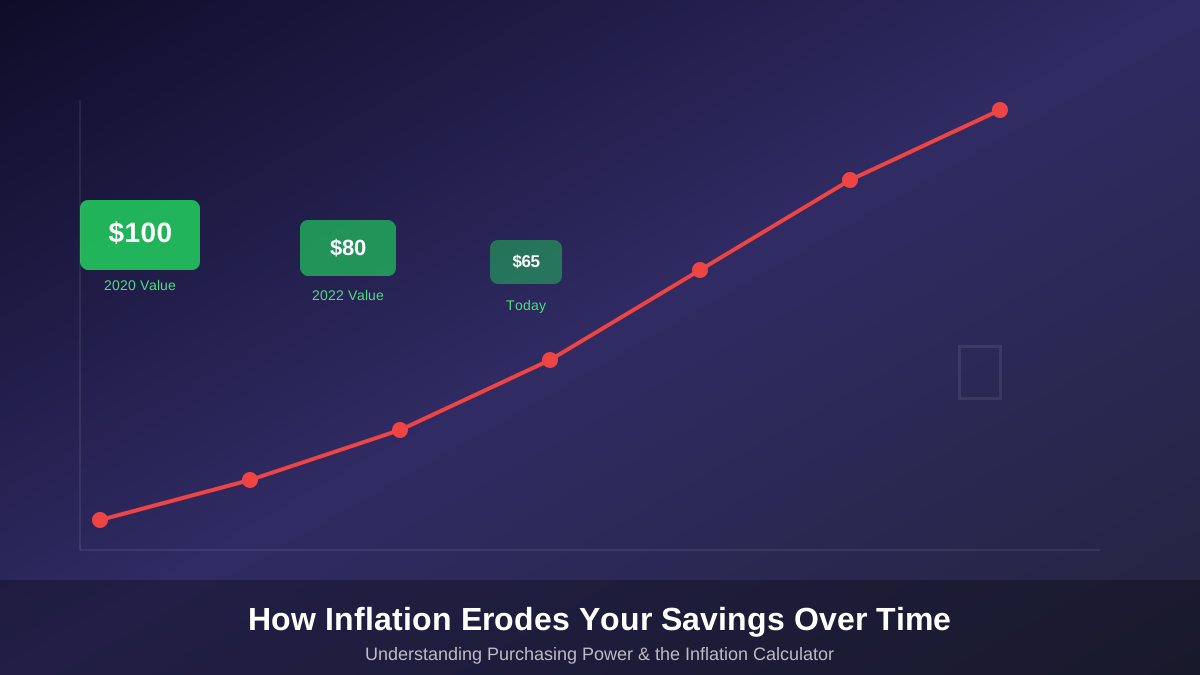
Inflation is a sustained increase in the general price level of goods and services. When the inflation rate is 4%, a $100 grocery basket that costs $100 today will cost $104 next year. That doesn't sound alarming — but sustained over time, the effect is dramatic.
The purchasing power of your dollar erodes. The same nominal amount of money buys fewer goods and services. Your $50,000 in a savings account earning 0.5% interest while inflation runs at 4% is shrinking in real terms by 3.5% per year.
The Purchasing Power Formula
Future Value in Today's Dollars = Present Value ÷ (1 + Inflation Rate)ⁿ
Where n = number of years
The Alarming Math: $100,000 Over 20 Years
Let's see what $100,000 in savings actually buys in 20 years under different inflation scenarios:
| Avg. Inflation Rate | Real Value After 10 Years | Real Value After 20 Years | Real Value After 30 Years |
|---|---|---|---|
| 2% (mild) | $82,035 | $67,297 | $55,207 |
| 3% (moderate) | $74,409 | $55,368 | $41,199 |
| 5% (elevated) | $61,391 | $37,689 | $23,138 |
| 7% (high) | $50,835 | $25,842 | $13,137 |
Under a 5% inflation environment over 30 years, $100,000 in cash would have the purchasing power of just $23,138 in today's terms. Money in a low-yield savings account is actively shrinking in real value.
The Real Return: The Number That Actually Matters
To know if your investments are truly growing, you need your real return — the inflation-adjusted return. The simplified formula:
Real Return ≈ Nominal Return − Inflation Rate
More precise: Real Return = [(1 + Nominal Rate) ÷ (1 + Inflation Rate)] − 1
Examples:
- High-yield savings account at 4.5% / inflation at 3.5%: Real return ≈ +1.0%
- Traditional savings at 0.5% / inflation at 3.5%: Real return ≈ −3.0% (losing wealth)
- S&P 500 historical average ~10.5% / inflation at 3.5%: Real return ≈ +7.0%
- I Bonds at 4.3% (inflation-linked) / inflation at 3.5%: Real return ≈ +0.8%
Historical Context: US Inflation Rates
The US Federal Reserve officially targets 2% annual inflation. Here's how the recent reality compared:
| Year | Annual Inflation Rate | Context |
|---|---|---|
| 2019 | 2.3% | Near target |
| 2020 | 1.2% | Pandemic-driven deflation |
| 2021 | 7.0% | Supply chain & stimulus surge |
| 2022 | 8.0% | 40-year high |
| 2023 | 4.1% | Cooling but still elevated |
| 2024 | 2.9% | Approaching target |
Strategies to Protect Your Savings from Inflation
1. Invest in Equities for Long-Term Growth
Over long periods (20+ years), broad stock market index funds like those tracking the S&P 500 have historically returned about 10% annually — well above long-run inflation. The short-term volatility is the price of those long-term real returns.
2. Series I Bonds (US Residents)
I Bonds earn a rate tied directly to inflation. They're guaranteed not to lose purchasing power and are backed by the federal government. The catch: you can't redeem them for 12 months and face a 3-month interest penalty if redeemed before 5 years. Limit of $10,000/year per person.
3. Treasury Inflation-Protected Securities (TIPS)
TIPS are federal bonds where the principal adjusts with inflation. Useful for conservative investors who want guaranteed inflation protection without stock market volatility.
4. Real Assets
Real estate, commodities, and infrastructure historically perform well during inflationary periods because their prices tend to rise with overall prices. REITs (Real Estate Investment Trusts) offer liquid exposure to real estate.
5. Keep Only Necessary Cash in Savings Accounts
Maintain 3–6 months of expenses in liquid savings for your emergency fund. Beyond that, cash sitting in a 0.5% savings account while inflation runs at 3% is a guaranteed real loss. Move investable assets into inflation-beating vehicles.
⚠️ The Retirement Savings Risk
Retirees living on fixed income are especially vulnerable to inflation. A 10-year retirement at 4% inflation requires nearly 50% more purchasing power at the end than the beginning. This is why financial advisors recommend retirees still maintain some equity exposure even in retirement — enough growth investment to outpace inflation over decades.
Calculate the Real Impact on Your Savings
Use our compound interest calculator to model the real growth of your investments after adjusting for inflation. Compare how much your savings will be worth in purchasing power terms under different return and inflation scenarios. For retirement planning, our retirement calculator lets you set an inflation assumption so you can plan the right savings rate to maintain your lifestyle.
See How Your Money Grows After Inflation
Model your real returns with our compound interest calculator — adjust for inflation to see true purchasing power growth.
Go to Compound Interest Calculator →